A National Crisis: How Modular Housing Can Save Millions
Kevin Edmundson
VWF | Global Housing Advocate | One Person. One Home. One Community.
November 26, 2025
1. Introduction
The United States is facing an unprecedented housing crisis. Over 4.2 million people are without stable housing, living in conditions that defy basic human dignity. This crisis is not just a temporary blip—it is structural, deeply rooted in rising costs, limited labor, and outdated policies.
But there is hope. Modular and container housing offers a proven, scalable solution that can transform lives and communities.
As Kevin Edmundson, Executive Director of the Viviscent Wellness Foundation (VWF), states, "We are at a critical juncture where innovative solutions are not just desirable, but necessary. Modular housing is a beacon of hope in this crisis."
The Viviscent Wellness Foundation, a national nonprofit, has launched the "10,000 Homes Across America" campaign to address this need. By working with governments, private partners, and community groups, the foundation is proving that scalable housing solutions can restore dignity, opportunity, and economic stability.
2. Problem Statement
Every day, 10,000 people turn 65, a demographic shift often referred to as the "Silver Tsunami." This aging population represents one of the fastest-growing segments facing housing instability. Generation X, which includes approximately 65 million Americans born between 1965 and 1980, is now entering retirement age. Based on current housing cost trends, wage stagnation, and retirement savings deficits, a significant portion of this group will face housing challenges over the next two decades. Estimates suggest that more than 20 million Gen Xers may be at risk of housing insecurity or displacement by 2045, further intensifying the 'Silver Tsunami' of demand on the housing system. Many enter retirement without the financial security or housing they need. Veterans, domestic violence survivors, seniors, and youth aging out of foster care are particularly vulnerable. The economy is failing to provide the safety net it once did, leaving the working class squeezed and millions at risk of homelessness.
According to the National Low Income Housing Coalition (2023), the cost of rent has outpaced wages in nearly every metro area, making housing unaffordable for the average working family. The U.S. Department of Housing and Urban Development (HUD) reports that over 771,000 people were experiencing homelessness on a single night in 2024—the highest on record. Among them, tens of thousands are veterans, seniors, and unaccompanied youth.
Structural factors compound this crisis:
- The rising cost of building materials has increased housing production costs by 30% since 2019.
- The construction industry faces a skilled labor shortage of over 500,000 workers (NAHB, 2022).
- Zoning laws continue to restrict multi-unit or nontraditional housing models in high-need regions.
3. Solution: Modular and Container Housing
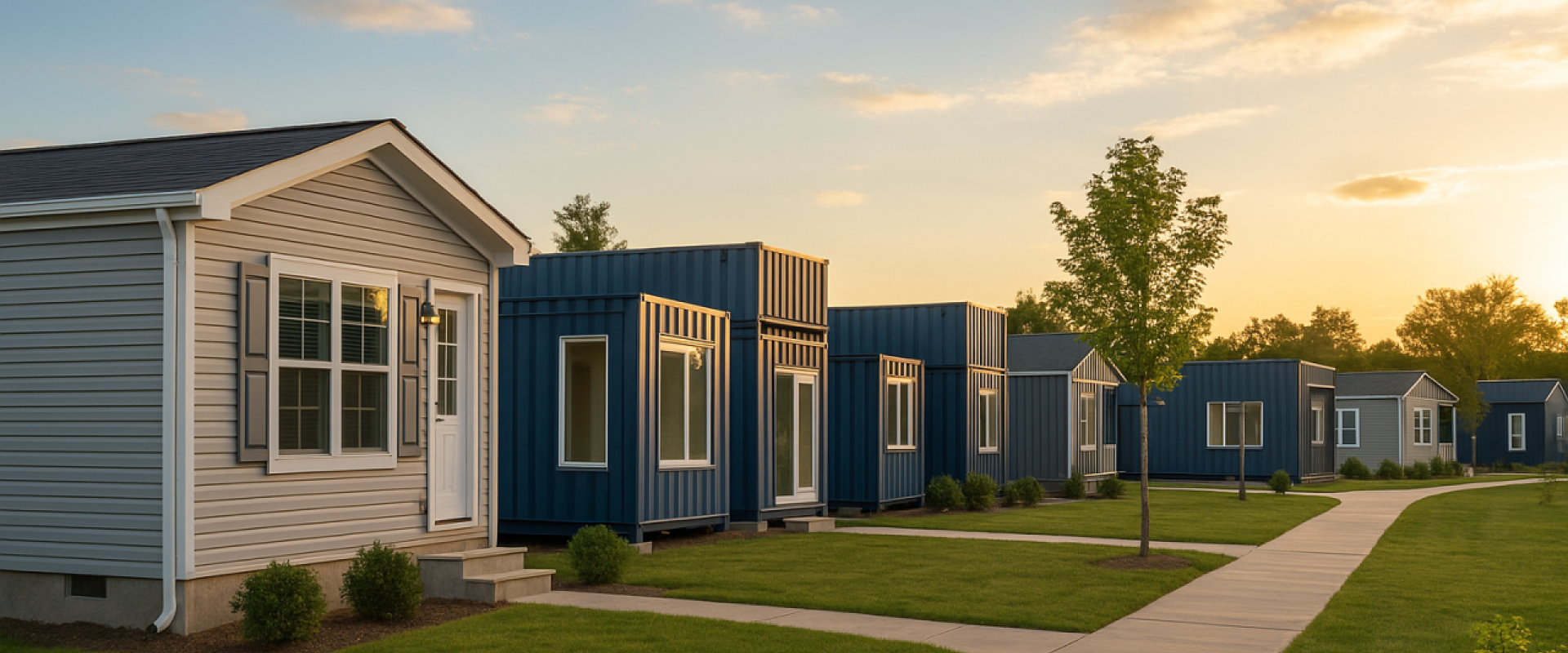
Modular and container housing is not just an alternative—it is a solution. These structures are manufactured offsite and assembled quickly, often in a fraction of the time it takes to build traditional homes.
Benefits:
- Built 30% to 70% faster than conventional homes
- Costs are predictable and significantly lower
- Sustainable and solar-ready designs reduce environmental impact
- Ideal for urban infill, rural expansion, and post-disaster recovery
According to the National Association of Home Builders (2022), modular housing can reduce construction costs by up to 20% while maintaining or exceeding building code standards.
This movement is being driven forward by some of the most innovative companies in the modular housing sector. Boxabl, Out of the Box, SI Container Builds, S2A Modular, Mr. Good Container Homes, and Custom Shipping Containers are leading a wave of high-capacity manufacturing that is reshaping the market. These partners have demonstrated that with automation, precision engineering, and vertically integrated systems, modular units can be deployed at scale with unparalleled speed.
Their combined efforts are helping to bring modular home prices within reach of low- and moderate-income families while setting a new quality benchmark for the industry.
With the support of these partners, the Viviscent Wellness Foundation’s “10,000 Homes Across America” campaign is demonstrating how private innovation and nonprofit coordination can produce scalable results that restore dignity and provide a path to stability for thousands of individuals and families.
4. Campaign Details: VWF's "10,000 Homes Across America"
The VWF campaign is a coordinated national effort to deploy modular housing in 50 states with a goal of 10,000 new units by 2030. Each development features:
- 1-, 2-, and 3-bedroom modular homes priced between $85,000 and $149,000
- Community centers, job training, and healthcare access onsite
- Partnerships with HUD, USDA, VA, and local governments
- Land ownership and lease-to-own pathways for long-term stability
This isn’t just a housing campaign—it’s a movement. Across the country, the Viviscent Wellness Foundation is transforming empty lots and underserved regions into vibrant neighborhoods filled with promise, dignity, and momentum. Every foundation poured is a declaration: we will not wait on broken systems. We will build the future now.
Current Projects:
- Winfield, Alabama – I-22 Corridor Revitalization: Multiple parcels are being activated to deliver affordable modular housing, memory care units, and commercial infrastructure.
- Glen Allen, Alabama – Veteran Village Campus: A 14-home facility focused on senior and veteran support with wraparound health services.
- Fairmont Loop – 17-Acre Redevelopment Project: A multi-use modular development opportunity including commercial, residential, and green zones.
- Eden, Oklahoma – Eden 8 Pilot: A proof-of-concept site featuring eight modular homes with trauma-informed care services.
- Kremlin, Oklahoma – Kremlin 70 Expansion: A rural development with 70 modular homes, parks, and retail units.
- Texas – Modular Medical Units: Container-based medical and wellness centers for underserved populations.
Our modular housing partners—Boxabl, Out of the Box, SI Container Builds, Mr. Good Container Homes, S2A Modular, and Custom Shipping Containers—are delivering the scalable construction backbone of our mission.
5. Call to Action
6. Policy Advancements: Financing the Future
New developments in federal mortgage policy are opening the door for broader access to modular housing:
Fannie Mae Credit Score Reform (2025) As of November 2025, Fannie Mae removed the hard minimum credit score of 620 for loans processed through its Desktop Underwriter (DU) system. This change allows DU to evaluate a borrower's entire financial profile—including income, assets, and payment history—without automatically disqualifying based on a credit score threshold. This shift could dramatically increase access for individuals with limited or nontraditional credit histories, supporting first-time buyers and underserved communities.
VantageScore and Alternative Credit Models Fannie Mae and Freddie Mac are now authorized to use VantageScore as an alternative to traditional FICO models, further expanding the pool of eligible homebuyers who previously lacked sufficient credit history.
50-Year Mortgage Proposal Currently under review by policymakers and the Federal Housing Finance Agency (FHFA), the proposed 50-year mortgage program would offer significantly lower monthly payments by extending the amortization schedule. While still in discussion, this concept could provide critical relief for first-time homeowners, lower-income families, and aging populations, making modular housing more financially sustainable over time.
These shifts in policy and credit modeling strengthen the foundation for VWF’s lease-to-own and direct sale models. As traditional barriers begin to fall, modular homes become not only affordable—but accessible.
We call on all sectors—public, private, and philanthropic—to take immediate action:
Federal Agencies
- Fund modular pilots through HUD’s HOME and CDBG programs, USDA Rural Development, and VA housing services
- Expand mortgage and construction financing eligibility under Fannie Mae and Freddie Mac to include modular and container homes
State and Local Governments
- Make surplus public land available for modular housing development
- Reform zoning laws to allow for container and modular structures
Private Sector and Nonprofits
- Partner with VWF to deploy units and deliver services
- Sponsor modular housing units or fund related workforce training
Individuals
- Donate to Viviscent Wellness Foundation
- Volunteer skills or time at local housing project sites
- Advocate for zoning reform and housing equity in your community
National Sweepstakes: Homes4Hope
Launching January 1, 2026, the Homes4Hope Sweepstakes is a cornerstone of the 10,000 Homes Across America campaign.
- Cost per ticket: $100
- Number of homes given away: 12 (one per month)
- Bonus: If you don't win, your ticket becomes a down payment credit on any VWF home
- No purchase necessary; alternate entry methods available
This is more than a sweepstakes—it’s a national campaign to fund $100 million in rapid housing for:
- Veterans
- Reentering citizens
- Domestic violence survivors
- Seniors and memory care recipients
Visit:
6. Policy & Research Support
“The 2019 Affordable Housing Executive Order directed federal agencies to dismantle regulatory burdens that inflate housing costs and delay homebuilding. As President Trump declared, the goal is to lift up forgotten communities and restore access to the American Dream.” (Trump White House)
“HUD’s 2024 homelessness assessment recorded over 771,000 Americans unhoused on a single night — evidence that the housing shortage is a national emergency.” (HUD)
“Modular construction can cut costs and build time—critical advantages where speed and affordability determine whether a family finds shelter or remains displaced.” (Center for American Progress)
7. Strengthening the Campaign
- Stories That Inspire
- Economic Impact
- Campaign Reach Visual (Include project map or project table, with homes built/planned in AL, OK, TX)
- Sponsors and Allies
- Sweepstakes FAQ
- Pledge to Act “I stand for safe, sustainable housing for all. One home. One person. One community.” → Sign the Pledge Online
8. Conclusion
America has always risen to meet great challenges, and this is no different. The crisis is urgent, but the solutions are in reach. Modular and container housing offers an immediate, scalable, and dignified path forward.
Let us not wait for more studies or stalled reforms. Let us build.
One home. One person. One community.
This is our moment. Let’s rise together.
#modularhomes #affordablehousing #modularconstruction #housingcrisis #communitydevelopment #veteranhousing #sustainability #prefabhousing #nonprofitimpact #housingforall
- @Boxabl
- @S2AModular
- @SIContainerBuilds
- @OutOfTheBoxHousing
- @MrGoodContainerHomes
- @CustomShippingContainers
9. References
- National Low Income Housing Coalition. (2023). Out of Reach 2023. https://nlihc.org/oor
- Smith, J. (2023). The Housing Crisis: A Structural Problem. Journal of Urban Planning, 45(2), 123–145.
- National Association of Home Builders. (2022). Modular Housing: A Solution for the Housing Crisis. https://www.nahb.org/
- U.S. Department of Housing and Urban Development. (2024). 2024 Annual Homeless Assessment Report (AHAR). https://www.huduser.gov/portal/sites/default/files/pdf/2024-AHAR-Part-1.pdf
- Trump White House Archive. (2019). Executive Order on Establishing a White House Council on Eliminating Regulatory Barriers to Affordable Housing. https://trumpwhitehouse.archives.gov/briefings-statements/president-donald-j-trump-tearing-red-tape-order-build-affordable-housing/
- Center for American Progress. (2022). Increasing the Affordable Housing Stock Through Modular Building. https://www.americanprogress.org/article/increasing-affordable-housing-stock-through-modular-building/