Housing Veterans and Underserved Families: Why the Time Is Now
Kevin Edmundson
VWF | Global Housing Advocate | One Person. One Home. One Community.
January 12, 2026
Homelessness surged 18% last year, but veteran homelessness hit a record low. Here’s how we scale that success for families—and how Viviscent Wellness Foundation is doing it.
Executive Summary
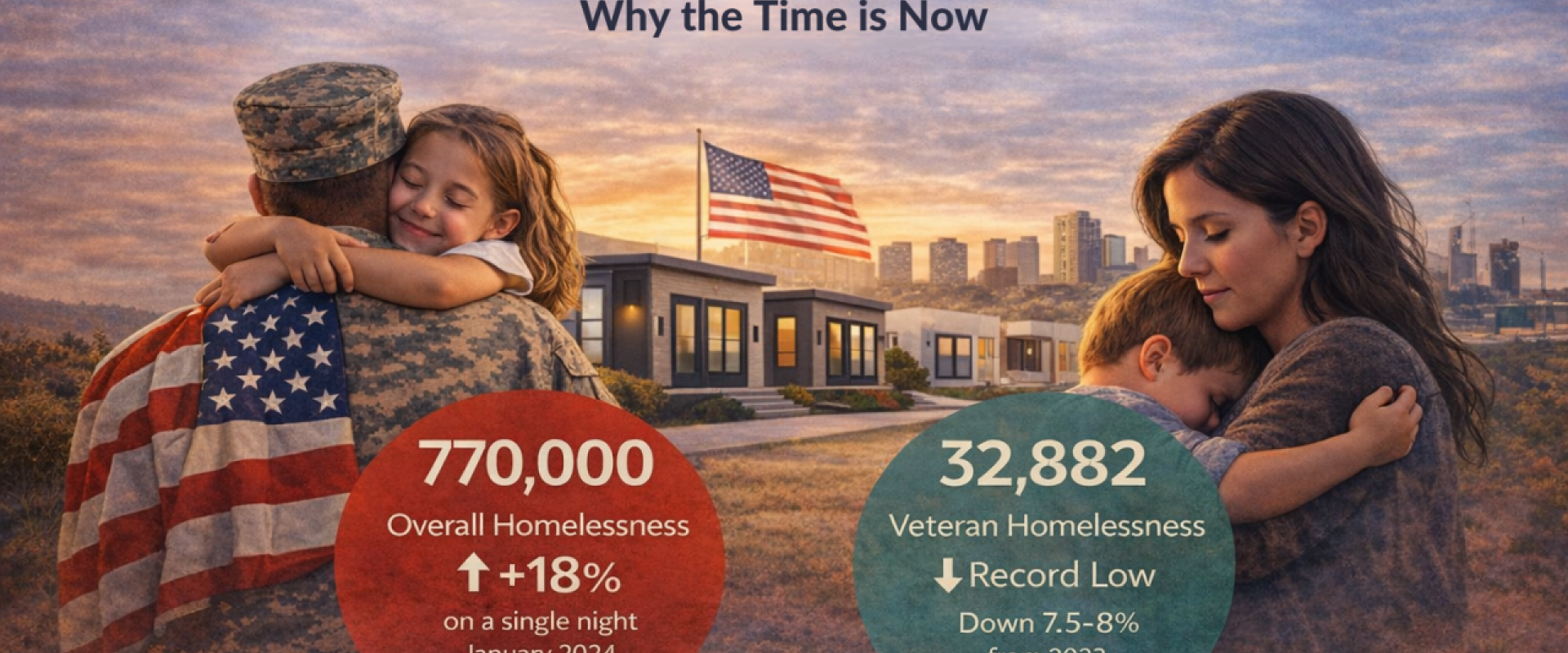
The United States is at a housing inflection point: overall homelessness surged to 770,000 on a single night in January 2024 (+18% year over year), while veteran homelessness fell to a record low—32,882, down 7.5–8% from 2023 (U.S. Department of Housing and Urban Development [HUD], 2024; U.S. Department of Veterans Affairs [VA], 2025). This contrast proves a decisive truth: homelessness is solvable when communities combine deep affordability, Housing First, and wraparound services at scale—exactly what HUD‑VASH delivers by pairing vouchers with VA case management and clinical care (HUD, n.d.; VA, n.d.).
Family homelessness escalated sharply. The Point in Time (PIT) count shows a 39.4% increase in people in families with children from 2023 to 2024, with 259,473 people in families counted on one night—an all‑time high (National Alliance to End Homelessness [NAEH], 2024; National Low Income Housing Coalition [NLIHC], 2025). Affordability pressures remain severe: 49.7% of renter households were cost burdened in 2023, with disproportionate burdens for Black and Hispanic renters (U.S. Census Bureau, 2024).
We have tools to act now. The Housing Supply Action Plan and PRO Housing grants help jurisdictions cut red tape and accelerate production and preservation (The White House, 2024; The White House, 2025). HOME‑ARP provides flexible, one‑time funds for rental housing, tenant based assistance, supportive services, and non congregate shelter for qualifying populations (HUD Exchange, 2024; HUD Exchange, 2025).
This report lays out a veterans playbook for families—scale supply, deepen affordability, and embed services—and shows how Viviscent Wellness Foundation (VWF) is operationalizing that playbook through lease to own homes with bundled maintenance and landscaping, integrated services, and partnerships that put families on a durable path to stability.
Table of Contents
1. Why Homes Matter: Health, Education, Work, and Community
2. The National Picture: Veterans and Families Moving in Different Directions
3. Regional Family Trends: Where and Why Pressure Is Rising
4. Comparing Families and Veterans: What We Can Apply
5. Solutions for Family Homelessness: A Veterans‑Inspired Playbook
6. How Viviscent Wellness Foundation Is Solving This Now
7. Financing and Delivery: Design, Operations, and Risk
8. Policy Alignment: Housing Supply Action Plan, PRO Housing, HOME‑ARP
9. Implementation Roadmap: 12‑Month Plan
10. Case Study: Ranger, Texas
Appendices: Glossary, Data Tables, APA References
1. Why Homes Matter: Health, Education, Work, and Community
Housing is the foundation of health, education, work, and community life. Stable housing reduces emergency department use and improves chronic disease management, especially when paired with case management and primary care, which is exactly how the HUD‑VASH model is designed (HUD, n.d.; VA, n.d.). For children, stability supports attendance, instructional continuity, and developmental progress; instability disrupts learning and raises toxic stress (HUD, 2024; U.S. Census Bureau, 2024). For working adults, a fixed address enables consistent employment and upskilling; instability and displacement are headwinds to labor force participation and income growth (The White House, 2024; HUD Exchange, 2025).
Programs that pair housing with services—from HUD‑VASH for veterans to HOME‑ARP supportive services for qualifying families—demonstrate measurable returns in reduced crisis spending and improved family stability (HUD Exchange, 2024; HUD Exchange, 2025). These returns accrue to local health systems, school districts, employers, and public safety budgets, which is why housing must be treated as critical infrastructure—not just shelter.
“Stable housing is health care, workforce infrastructure, and an education intervention all at once.”
2. The National Picture: Veterans and Families Moving in Different Directions
Veteran homelessness reached a record low in January 2024. Veterans counted as homeless fell to 32,882—a 7.5–8% drop from 2023—with unsheltered veterans declining 10–11% to 13,851 (VA, 2025; HUD, 2024). This progress reflects permanent housing placements (47,925 in FY 2024) and nearly 90,000 veteran households leasing through HUD‑VASH vouchers (USICH, 2024; HUD, 2024).
By contrast, people in families with children rose 39.4% year over year to 259,473 on a single night in January 2024—the highest recorded (NAEH, 2024; NLIHC, 2025). The prior year already showed stress: family homelessness increased 15.5% from 2022 to 2023 (HUD, 2023; NAEH, 2024). While veteran homelessness declines, families—especially those with extremely low incomes—face affordability barriers and fragmented supports that push them into shelters, motels, or doubled‑up situations (U.S. Census Bureau, 2024; NLIHC, 2025).
“Veteran homelessness is falling because housing plus services are funded and coordinated. Families need the same formula.”
3. Regional Family Trends: Where and Why Pressure Is Rising
Migration and disaster displacement drove sharp local increases in family homelessness. HUD reports that family homelessness more than doubled in 13 communities affected by migration, while in the other 373 communities family homelessness rose less than 8% (HUD, 2024; NAEH, 2024). Disaster impacts mattered too—for example, in Hawai‘i more than 5,200 people slept in disaster shelters on PIT night due to the Maui fire (Weekly View, 2025; HUD, 2024).
Affordability hotspots amplify risk. Cost burdens for renters are highest in several states: Florida (60% of renters cost burdened), Nevada (57%), and California (55%) (Eye on Housing/NAHB, 2025; U.S. Census Bureau, 2024). These hotspots correlate with higher eviction filings and shelter entries among families, especially where vacancy rates are tight and rents exceed ELI thresholds (U.S. Census Bureau, 2024; JCHS, 2025).
“Where rents outpace wages and disaster strikes, families enter homelessness fast unless prevention and rapid rehousing are in place.”
4. Comparing Families and Veterans: What We Can Apply
Trajectory: veteran homelessness is down 55% since 2010—proof that focused, evidence based strategies deliver population‑level results. Family homelessness has spiked—+15.5% (2022→2023) and +39.4% (2023→2024)—as affordability, migration, and disasters converge (USICH, 2024; VA, 2025; HUD, 2023; NAEH, 2024).
Design: veterans benefit from HUD‑VASH (voucher with case management and clinical services), coordinated entry, and intensive outreach. Families need similar design: deep affordability, embedded services, and unified housing and services delivered through coordinated entry and school‑linked supports (HUD, n.d.; VA, n.d.; The White House, 2024; HUD Exchange, 2025).
Coordination: veteran progress reflects interagency alignment (HUD–VA–USICH) and outcome tracking. Families require alignment across CoCs, PHAs, health systems, school districts, child welfare, and DV services, backed by sustained funding and quarterly performance management (USICH, 2024; HUD Exchange, 2024).
5. Solutions for Family Homelessness: A Veterans‑Inspired Playbook
Scale supply and preservation (cut red tape)
Adopt PRO Housing reforms—accessory dwelling units, missing middle housing, expedited permitting, flexible parking, and transit‑oriented siting—to cut time and cost to build and preserve (The White House, 2024; The White House, 2025). Prioritize acquisition and preservation near schools and services with income‑restricted covenants (JCHS, 2025; NLIHC, 2025).
Deliver deep affordability (subsidy and operating support)
Pair project based vouchers and HOME‑ARP TBRA with operating supports to reach ELI affordability for families, targeting buildings near schools and transit (HUD Exchange, 2025; HUD Exchange, 2024). Use outcome‑oriented financing that combines LIHTC equity with service contracts and Federal Financing Bank risk sharing for interest‑rate predictability (The White House, 2024; JCHS, 2025).
Embed wraparound services (housing and care)
Stabilize families first, then add case management, behavioral health, childcare navigation, transportation supports, and school liaisons—mirroring HUD‑VASH but tailored to families (HUD, n.d.; VA, n.d.). Expand legal aid and enforce prohibitions on certain non-rent fees in HUD‑assisted housing; provide arrears assistance and mediation to prevent eviction (USICH, 2024; The White House, 2024).
Rapid response for disasters and migration
Deploy non congregate shelter with rapid rehousing pathways; prioritize school continuity and trauma‑informed supports; adjust targeting quarterly using PIT/HIC and ACS cost burden data (HUD Exchange, 2025; HUD, 2024; U.S. Census Bureau, 2024).
Landlord engagement and leasing velocity
Offer guarantees, expedited inspections, and direct help lines; standardize family friendly leasing (appropriate bedroom counts, proximity to schools and childcare) and retention supports (HUD, n.d.; VA, 2025).
6. How Viviscent Wellness Foundation Is Solving This Now
Lease to own with bundled stability. VWF delivers lease to own homes that include maintenance and landscaping in the monthly cost. This approach reduces unexpected expenses, improves budgeting, and removes common triggers for housing instability. Families gain a clear path to ownership without the shocks of uncovered repairs or yard care costs that often derail tenancy.
Veterans playbook for families. We stabilize with housing first, then add services: case management, behavioral health referrals, child care navigation, legal aid, and workforce supports. The sequence mirrors what works for veterans—home first, services follow—but adapts content for family realities (HUD, n.d.; VA, n.d.). We partner with local CoCs and PHAs to prioritize families exiting shelter and coordinate with schools to protect attendance and progress (HUD Exchange, 2025; USICH, 2024).
Financing aligned to outcomes. We structure deals to reach ELI affordability where possible by pairing project based vouchers or HOME‑ARP TBRA with operating supports. Consistent with the Housing Supply Action Plan, we collaborate with jurisdictions to streamline approvals, deploy PRO Housing reforms, and site homes near schools, employment centers, and transit (The White House, 2024; The White House, 2025).
Scalable pipeline and JV delivery. We standardize designs and service MOUs, enabling scale across phases—such as the Ranger, Texas site expansion plan to 80 units—and collaborate through a 50/50 joint venture with Mr. Good Container Homes LLC (Florida) to produce units faster while maintaining quality and service integration.
“VWF’s lease to own model bundles maintenance and landscaping, turning unstable rentals into pathways to ownership.”
7. Financing and Delivery: Design, Operations, and Risk
Operating economics are strained by insurance, property taxes, and utilities. Designing resilience—energy efficiency, flood and fire mitigation—protects long‑run economics and tenant safety (JCHS, 2025; HUD, 2024). Outcome‑oriented financing aligns capital to results: LIHTC equity plus service contracts, project based vouchers, and predictable debt via Federal Financing Bank risk sharing improvements (The White House, 2024; JCHS, 2025).
Landlord engagement strategies—guarantees, rapid inspections, responsive property management—expand unit supply and speed leasing. These practices helped drive veteran placements and should be generalized for family placements, including owner education and retention supports (HUD, n.d.; VA, 2025).
8. Policy Alignment: Housing Supply Action Plan, PRO Housing, HOME‑ARP
The Housing Supply Action Plan and PRO Housing grants incentivize local reforms that reduce regulatory barriers and accelerate production and preservation (The White House, 2024; The White House, 2025). HOME‑ARP provides flexible funding for rental housing, tenant based assistance, supportive services, non congregate shelter, and nonprofit capacity building for qualifying populations (HUD Exchange, 2024; HUD Exchange, 2025).
Together, these policies create tailwinds for communities to expand supply, lock in affordability, and sustain services. With strong coordination across HUD, VA, USICH, PHAs, CoCs, school districts, and health systems, communities can replicate veteran success for families at scale (USICH, 2024; HUD, 2024).
9. Implementation Roadmap: 12‑Month Plan
Quarter 1: Targeting and capacity
Use PIT/HIC and ACS data to map hotspots; set ELI targets; identify buildings for acquisition and preservation (HUD, 2024; U.S. Census Bureau, 2024). Stand up landlord engagement unit; adopt expedited inspection protocols (HUD, n.d.; VA, 2025).
Quarter 2: Deals and vouchers
Close acquisition or preservation deals near schools; enroll in PRO Housing reforms; apply HOME‑ARP TBRA for families (The White House, 2024; HUD Exchange, 2025). Procure service partners for case management, legal aid, childcare navigation, and behavioral health (USICH, 2024; HUD Exchange, 2024).
Quarter 3: Placements and retention
Move in families with coordinated entry prioritization; track attendance, employment, and health care engagement; deploy arrears assistance and mediation early (NAEH, 2024; USICH, 2024). Launch school liaisons and transportation supports; monitor outcomes monthly (HUD, 2024; U.S. Census Bureau, 2024).
Quarter 4: Optimization and scale
Expand to additional buildings; add non congregate surge capacity for disaster or migration events; issue quarterly public dashboards (Weekly View, 2025; HUD Exchange, 2025). Backfill financing with LIHTC and outcome‑based service contracts; lock in affordability covenants (JCHS, 2025; NLIHC, 2025).
10. Case Study: Ranger, Texas
Ranger, Texas illustrates how a phased pipeline can grow to 80 units with consistent design, permitting, and service MOUs. Phase one focuses on rapid delivery of units for veterans and families exiting shelter, using lease to own contracts with bundled maintenance and landscaping. Phase two scales with additional parcels, standardized modular components, and capital stack alignment (LIHTC, bank debt, vouchers, and HOME‑ARP TBRA where available). Each phase includes school district MOUs, health system partners, landlord engagement protocols, and quarterly dashboards for outcomes and retention.
Call to Action
The nation’s success in reducing veteran homelessness shows that ambition plus coordination delivers measurable results. If we combine supply expansion, deep affordability, and robust services—and keep outcomes front and center—we can replicate the veteran model to serve families at scale. Viviscent Wellness Foundation is acting on that model now, building and preserving pathways to ownership that stabilize families and strengthen communities. The time is now to align capital, policy, and care: build, preserve, subsidize, and support—so every veteran and every underserved family has a home and a path to stability (USICH, 2024; The White House, 2025).
APA References
Eye on Housing (National Association of Home Builders). (2025, November 24). Where renters and owners face the highest cost burdens. https://eyeonhousing.org/2025/11/where-renters-and-owners-face-the-highest-cost-burdens/
Joint Center for Housing Studies of Harvard University. (2025). The state of the nation’s housing 2025. https://www.jchs.harvard.edu/sites/default/files/reports/files/Harvard_JCHS_The_State_of_the_Nations_Housing_2025.pdf
National Alliance to End Homelessness. (2024, December 27). HUD releases 2024 Annual Homelessness Assessment Report. https://endhomelessness.org/media/news-releases/hud-releases-2024-annual-homelessness-assessment-report/
National Low Income Housing Coalition. (2025, January 13). HUD releases 2024 Annual Homeless Assessment Report (Memo to Members). https://nlihc.org/resource/hud-releases-2024-annual-homeless-assessment-report
National Low Income Housing Coalition. (2025, March 13). The Gap 2025: A shortage of affordable homes (Press release). https://nlihc.org/news/nlihc-releases-gap-2025-shortage-affordable-homes
Pew Research Center. (2024, October 25). A look at the state of affordable housing in the U.S. https://www.pewresearch.org/short-reads/2024/10/25/a-look-at-the-state-of-affordable-housing-in-the-us/
The White House. (2024, August 13). Fact sheet: New actions to lower housing costs by cutting red tape to build more housing. https://bidenwhitehouse.archives.gov/briefing-room/statements-releases/2024/08/13/fact-sheet-biden-harris-administration-takes-new-actions-to-lower-housing-costs-by-cutting-red-tape-to-build-more-housing/
The White House. (2025, January 14). Fact sheet: Final actions to build more housing and bolster renter protections. https://bidenwhitehouse.archives.gov/briefing-room/statements-releases/2025/01/14/fact-sheet-biden-harris-administration-takes-final-actions-to-build-more-housing-and-bolster-renter-protections/
U.S. Census Bureau. (2024, July 30). Quarterly Residential Vacancies and Homeownership, Q2 2024. https://endhomelessness.org/wp-content/uploads/2024/10/currenthvspress.pdf
U.S. Census Bureau. (2024, September 12). Nearly half of renter households are cost burdened. https://www.census.gov/newsroom/press-releases/2024/renter-households-cost-burdened-race.html
U.S. Department of Housing and Urban Development. (2023). 2023 Point in Time count: By the numbers. https://www.hud.gov/sites/dfiles/PA/documents/2023_PIT_Count_By_the_Numbers.pdf
U.S. Department of Housing and Urban Development. (2024, December 27). 2024 Annual Homelessness Assessment Report (AHAR), Part 1: Point in Time estimates of homelessness. https://www.huduser.gov/portal/sites/default/files/pdf/2024-AHAR-Part-1.pdf
U.S. Department of Housing and Urban Development. (2024, December 30). HUD releases January 2024 Point in Time Count report (HUD Exchange). https://www.hudexchange.info/news/hud-releases-2024-ahar-report/
U.S. Department of Housing and Urban Development. (n.d.). HUD–Veterans Affairs Supportive Housing (HUD‑VASH). https://www.hud.gov/helping-americans/housing-choice-vouchers-homeless-veterans
U.S. Department of Veterans Affairs. (2025, January 11). Veteran homelessness reaches record low, decreasing by 7.5% since 2023. https://news.va.gov/137562/veteran-homelessness-reaches-record-low-2023/
U.S. Department of Veterans Affairs. (n.d.). HUD‑VASH program overview. https://www.va.gov/homeless/hud-vash.asp
U.S. Interagency Council on Homelessness. (2024, November 11). Under Biden–Harris Administration, veteran homelessness drops to lowest on record. https://www.usich.gov/news-events/news/under-biden-harris-administration-veteran-homelessness-drops-lowest-record
HUD Exchange. (2024, April). HOME‑ARP fact sheets. https://www.hudexchange.info/resource/6480/home-arp-implementation-notice-fact-sheets/
HUD Exchange. (2025). HOME‑ARP program overview and guidance. https://www.hudexchange.info/programs/home-arp/
Weekly View. (2025, January 2). HUD releases Jan. 2024 Point in Time report on nation (Maui fire impact). https://weeklyview.net/2025/01/02/hud-releases-jan-2024-point-in-time-report-on-nation/
#HousingFirst #HUD #VA #USICH #AffordableHousing #VeteransHousing #FamilyHomelessness #HOMEARP #PROHousing #HousingSupplyActionPlan #LIHTC #PublicHousingAuthorities #ContinuumOfCare #EvictionPrevention #HousingPolicy #GovPolicy #StateHousingAgencies #CommunityDevelopment #HomelessnessResponse #DisasterRecovery #TransitOrientedDevelopment #ResilientHousing #EquitableDevelopment #HealthAndHousing #PlaceBasedInvestments #DataDrivenPolicy