A Copyable Housing Model for America: Why the Viviscent and Fractional real estate Structure Could Matters
A government-aligned, investor-ready, grant-credible framework for affordable housing, resilience, and scalable public-private impact
By Kevin Edmundson
Publisher Note
This article is written as a strategic thought leadership piece intended to outline a repeatable housing framework. It references categories of real estate finance, public-private housing development, and fractional ownership structures in a general policy and strategic context. Any final deployment of this model would remain subject to legal review, securities compliance, local zoning, underwriting, program eligibility, and formal partnership documentation.
Executive Summary
The United States does not have a shortage of housing conversations. It has a shortage of deployable, financeable, repeatable housing systems.
That distinction matters.
Across the country, local governments, nonprofit organizations, housing authorities, community development leaders, impact investors, family offices, philanthropies, and modular manufacturers are all confronting the same structural challenge: how to move affordable and workforce housing from aspiration to execution.
The Viviscent x Fractional real estate. framework is designed as a practical answer to that challenge.
This is not a theory piece about housing. It is a systems model. It is a replicable structure intended to support:
- affordable and workforce housing production
- long-term nonprofit and mission retention
- private capital participation
- local operating sustainability
- HUD and government-aligned deployment pathways
- resilience, energy efficiency, and community stabilization
At its strongest, this model is not simply a partnership between two organizations. It is a policy-aligned delivery framework that other cities, counties, nonprofits, housing developers, land donors, and aligned investors can adapt and deploy in their own communities.
That is the real opportunity.
America needs housing models that can be copied.
Introduction: Why America Needs a New Housing Delivery Model
Housing is now one of the defining infrastructure, health, workforce, and economic development issues of this decade.
It affects nearly every major public policy category:
- poverty reduction
- economic mobility
- workforce participation
- school continuity
- disaster recovery
- veteran stability
- senior wellbeing
- reentry and recidivism reduction
- public health
- local tax base resilience
Yet despite years of policy debate, most communities still face the same operational barriers:
- not enough housing supply
- land that sits idle or underused
- projects that take too long to entitle and finance
- capital stacks that are too fragile
- construction timelines that break budgets
- affordable housing projects that struggle to sustain themselves after launch
This is not a niche issue. It is structural.
The National Low Income Housing Coalition reported in 2026 that the United States faces a shortage of 7.2 million affordable and available rental homes for extremely low-income renter households, with only 35 affordable and available homes for every 100 extremely low-income renter households nationwide (National Low Income Housing Coalition [NLIHC], 2026). (nlihc.org)
That means the need is not incremental.
It is systemic.
The answer cannot be one-off projects alone. It must be repeatable delivery systems that can move across jurisdictions, capital sources, and project sizes while staying financially and operationally intact.
That is the lens through which the Viviscent x Fractional real estate. structure should be understood.
Section I. The Problem We Are Actually Trying to Solve
Too many housing discussions are framed too narrowly.
The public conversation often separates housing into categories such as:
- affordable housing
- workforce housing
- veteran housing
- rural housing
- recovery housing
- supportive housing
- attainable homeownership
- disaster recovery housing
- transitional housing
- senior and memory care housing
These categories matter for policy and program design. But from a systems standpoint, they are all downstream expressions of the same core issue:
America does not produce, preserve, and operate enough appropriately priced housing fast enough for the people and communities who need it.
Brookings has repeatedly argued that affordability challenges are deeply connected to constrained housing supply and the barriers that keep communities from adding enough homes where they are needed (Brookings Institution, 2024). (census.gov)
That bottleneck shows up everywhere.
In growing regions, it shows up as rising rents and home prices.
In rural areas, it shows up as stagnant housing stock, aging units, and a lack of replacement inventory.
In disaster zones, it shows up as delayed recovery and prolonged displacement.
In veteran and reentry populations, it shows up as instability that drives broader social and economic costs.
In workforce recruitment, it shows up as employers who cannot attract or retain labor because employees cannot afford to live nearby.
So when we talk about a housing model, we are not talking about walls and roofs alone.
We are talking about the underlying civic infrastructure that supports community continuity.
Section II. What the Viviscent x Fractional real estate. Structure Is
At its core, the Viviscent x Fractional real estate. framework is a hybrid housing delivery and ownership model designed to solve a central challenge:
How do you create housing that is simultaneously:
- investable
- governable
- locally manageable
- mission aligned
- scalable
- and financially durable over time?
The proposed structure combines six core elements and is designed to be compatible with emerging real estate participation platforms, including companies that specialize in fractional real estate, tokenized ownership models, investor syndication, or regulated alternative real estate access structures. This article does not state that Viviscent is formally partnered with any one platform for all future projects. Instead, it outlines a framework that can be evaluated for compatibility with companies operating in this category.
The proposed structure combines six core elements:
1. Efficient Housing Delivery
The model is designed around modular, factory-aligned, and repeatable housing approaches wherever feasible.
2. Retained Mission Ownership
Viviscent retains a long-term ownership interest in assets, rather than exiting entirely after buildout or sale.
3. Structured Investor Participation
The remaining ownership position can be opened to outside investors through a structured real estate or fractional participation framework.
4. Built-In Property Operations
Management, compliance, tenant communication, maintenance coordination, and occupancy oversight are built into the model from the beginning.
5. Local Execution Capacity
The structure is designed to be operated in real communities, not just modeled in a spreadsheet.
6. Reinvestment Logic
Revenue and retained value are intended to help fund future housing, rather than requiring every new project to start from zero.
This logic is already reflected in the current working Fractional real estate. structure, which includes retained ownership tiers, defined management economics, internal build assumptions, and project-level deployment across multiple U.S. markets. That matters because most housing projects fail not because the need is unclear, but because the system around the housing is incomplete.
Section III. Why This Structure Is Different From Typical Housing Efforts
Many housing projects are built on one of two weak foundations.
Weak Foundation A: The One-Time Capital Model
A project receives a grant, a donor contribution, or a one-time subsidy, gets built, and then struggles later because there is not enough retained economics to support operations, maintenance, scaling, or replication.
Weak Foundation B: The Pure Investor Model
A project is built entirely around investor returns with little regard for long-term affordability, resident stability, or mission continuity.
Both models have limitations.
The first often lacks long-term durability.
The second often lacks social alignment.
The Viviscent x Fractional real estate. structure is intended to sit between those two extremes.
It aims to create a blended mission-capital framework where:
- the mission does not disappear after the ribbon cutting
- the operating layer is funded
- investors can understand the economics
- housing can be deployed repeatedly rather than once
That is a meaningful distinction.
Section IV. Why Government, HUD, and Grantmakers Should Take This Seriously
If a housing model is going to matter beyond one project, it must speak the language of implementation.
That means it must align with how government and institutional funders think.
Government agencies do not primarily evaluate housing ideas based on enthusiasm. They evaluate them based on whether they can:
- increase housing supply
- reduce barriers to delivery
- improve affordability outcomes
- align with program rules
- preserve long-term community benefit
- withstand compliance review
- and operate sustainably after deployment
This is exactly where the Viviscent x Fractional real estate. structure becomes relevant.
HUD Alignment
HUD’s affordable housing ecosystem continues to emphasize production, preservation, and partnership. HUD states that the HOME Investment Partnerships Program provides formula grants to states and localities that are often used in partnership with nonprofit groups to build, buy, or rehabilitate affordable housing for rent or homeownership, or to provide rental assistance to low-income households (U.S. Department of Housing and Urban Development [HUD], n.d.). (hud.gov)
That language matters because it confirms a core reality: nonprofit-led housing partnerships are not fringe. They are already part of the federal housing delivery ecosystem.
The Viviscent x Fractional real estate. structure can fit into that logic because it creates a framework that can support:
- nonprofit participation
- local jurisdiction alignment
- mixed funding pathways
- and durable ownership/operating roles
HUD and Innovation Alignment
HUD has also continued to elevate innovative housing systems as part of the national affordability conversation. The 2025 Innovative Housing Showcase highlighted modular, manufactured, 3D-printed, and other scalable housing methods as part of HUD’s effort to spotlight solutions that can reduce housing costs and expand supply (HUD, 2025a; HUD, 2025b). (hud.gov)
This is a significant policy signal.
It means the federal conversation is increasingly open to housing systems that are:
- faster to deploy
- more standardized
- more efficient
- and less dependent on slow, fragmented, conventional construction workflows
That directly supports the strategic logic behind modular and repeatable deployment models.
Disaster and Resilience Alignment
FEMA guidance also reinforces a parallel public policy need: communities should not simply rebuild housing vulnerability after storms and disasters. Recovery investments should improve resilience to flood, wind, and future events (Federal Emergency Management Agency [FEMA], 2025). (energy.gov)
That matters for states and regions facing:
- hurricanes
- tornadoes
- flooding
- wildfire recovery
- and infrastructure degradation
A repeatable modular housing system, deployed with resilient design standards and site-appropriate engineering, is not just a housing solution.
It is a disaster readiness and community continuity solution.
Section V. Why This Model Is Grant-Credible
Many organizations misunderstand what makes a housing model attractive to grantmakers.
Grantmakers are not looking only for need. Need is assumed.
They are looking for:
- feasibility
- leverage
- scalability
- operational credibility
- measurable outcomes
- sustainability after grant dollars are spent
The Viviscent x Fractional real estate. framework is grant-credible because it can be framed as a model that addresses all six.
1. Feasibility
The structure is tied to actual project inventory, not hypothetical future possibilities.
The current pipeline includes launch-ready homes, completed homes, partially completed homes, lots, development-ready sites, and regional expansion opportunities across multiple states. ### 2. Leverage
The model is designed to layer and attract different forms of support, including:
- land donations or discounts
- local government support
- philanthropic participation
- investor participation
- and potentially grant-aligned development or predevelopment funding
3. Scalability
The structure is not dependent on one site or one market. It is already being organized as a multi-market system. ### 4. Operational Credibility
Unlike many concept-stage housing proposals, this structure includes a defined management layer. That matters because funders increasingly care about who will actually operate and maintain housing after development.
5. Measurable Outcomes
This model can support measurable outputs such as:
- units delivered
- residents housed
- occupancy rates
- lease-to-own conversions
- veterans served
- families stabilized
- local jobs supported
- utility cost savings from energy features
- community redevelopment outcomes
6. Sustainability Beyond the Grant
This may be the most important point.
Grantmakers increasingly favor models that do not collapse when the initial funding cycle ends.
A structure with retained ownership, operating revenue, and reinvestment logic is stronger than one that requires every future phase to begin from scratch.
Section VI. Why Investors Should Take This Seriously
To be credible, a housing model must be able to speak to investors without abandoning the mission.
That is one of the central strengths of this framework.
Investors do not need vague moral language. They need understandable structure.
This model provides that.
At a high level, this fractional real estate oriented framework is built around a straightforward concept:
- Viviscent retains a defined ownership position
- the remaining position can be opened to investor-facing participation
- property management and operations are built in
- underwriting can be done on actual local market assumptions
- and the assets can be modeled individually or in grouped offerings
That gives investors several things they usually want:
1. Defined Asset Logic
This is not abstract social impact. It is real estate.
2. Visible Cash Flow Logic
The structure includes rent assumptions, expense logic, management treatment, and asset-level economics. ### 3. Geographic Diversification Potential
The current inventory spans multiple markets and project sizes. ### 4. Mission-Aligned Brand Positioning
Many investors, especially family offices, ESG-aligned capital groups, donor-advised fund participants, and values-based real estate partners, are increasingly interested in housing structures that generate both returns and visible social outcomes.
5. Platform Repeatability
Investors are often more interested in repeatable systems than in isolated deals.
That is where this structure becomes more valuable over time.
It is not just a property. It is a deployment framework.
Section VII. Why Faster, Stronger, Lower-Cost Housing Delivery Changes the Math
One of the most overlooked barriers in housing is not demand. It is delivery friction.
Traditional site-built housing is often slowed by:
- labor shortages
- subcontractor fragmentation
- weather delays
- material volatility
- rework and coordination failures
- long inspection and sequencing timelines
These are not minor inconveniences. They are major cost drivers.
This is why repeatable, engineered, panelized, and factory-supported construction systems matter.
And this is also where one of the most important real-world parts of the Viviscent housing strategy must be clearly stated.
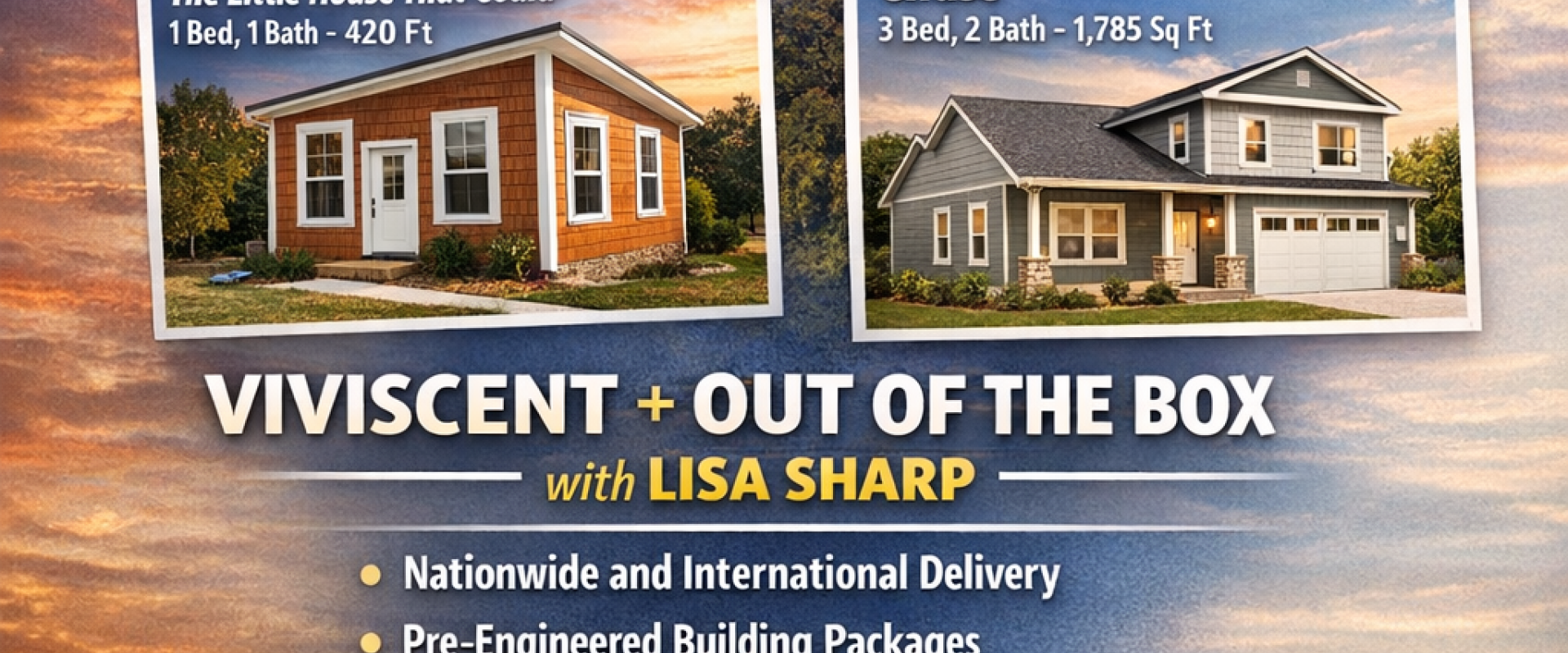
Viviscent is actively building housing through a dual design and delivery collaboration with Out of the Box, including direct collaboration with Lisa Sharp, to help bring stronger, faster, and more cost-stable housing to market.
This matters because these homes are not being framed as disposable emergency shelters or low-quality temporary structures.
They are intended to be real replacement homes, built to last, built for real families, and built to perform in difficult environments.
Not Disposable Housing. Real Housing.
There is a serious misconception in the market that any faster housing system must automatically mean lower quality housing.
That assumption is wrong.
The Viviscent housing line is being positioned around homes that are:
- engineered for long-term livability
- designed for replacement housing and primary residence use
- intended to support family, workforce, and community housing demand
- built for durability, repeatability, and speed
- and structured to help lower total delivered housing cost without lowering housing dignity
This is one of the reasons the collaboration matters.
It is not about building “cheap” housing.
It is about building better housing economics.
Why the $160 Per Square Foot Threshold Matters
One of the most important strategic benchmarks in this model is the ability to target housing delivery at approximately $160 per square foot.
If that threshold can be achieved at scale while maintaining structural quality, design consistency, and long-term durability, it has the potential to materially change how communities think about housing feasibility.
That is because many projects fail before they ever begin due to one simple problem:
the cost to build is too high for the rents, sale prices, or subsidy structure to support.
A lower, more disciplined, more repeatable cost basis changes that equation.
It improves the viability of:
- workforce housing
- attainable ownership housing
- lease-to-own housing
- disaster replacement housing
- infill redevelopment
- nonprofit-led housing portfolios
- and investor-aligned housing production
That is not a marketing statement.
That is an underwriting statement.
Built to Perform
Another major differentiator is durability.
The Viviscent housing line, in collaboration with Out of the Box, is being positioned around homes designed to withstand up to 180-mile-per-hour wind loads, subject to engineering, site conditions, code compliance, and final local approvals.
That matters in a country increasingly affected by:
- hurricanes
- tornadoes
- high-wind storm events
- and insurance-driven housing risk
This is one of the reasons this model has relevance beyond affordability alone.
It is also a resilience conversation.
Happening Now, Not Someday
This is also important to say plainly:
These homes are not just conceptual.
They are happening now.
They are being actively positioned and made available for sale now as part of a broader effort to help change how replacement housing, workforce housing, and long-term attainable housing are delivered.
That immediacy matters.
Because markets do not need another ten-year conversation.
They need deployable inventory.
The Viviscent Housing Line
The Viviscent housing line is intended to support a wide range of housing needs, from compact housing to large family homes, with design pathways ranging from approximately 360 square feet up to 5,000 square feet.
This creates unusual flexibility for the same housing ecosystem to support:
- compact workforce or transitional housing
- one-bedroom and two-bedroom attainable housing
- family-sized three-bedroom homes
- expanded multi-use family housing
- office-equipped live-work style homes
- and larger custom or executive family housing where market conditions support it
Current example models include:
- Awesome — 3 bedroom, 2 bath, 1,352 square feet
- Epic — 2 bedroom, 2 bath, 936 square feet
- Chase — 3 bedroom, 2 bath, 1,785 square feet
- Fortner — 3 bedroom, 2 bath with office space, 1,352 square feet
- Awesome 2 — 2 bedroom, 2 bath, 1,352 square feet
- Aerie — 2 bedroom, 2 bath, 936 square feet
- The Little House That Could — 1 bedroom, 1 bath, 420 square feet
This range matters because one of the biggest mistakes in housing strategy is assuming every community needs the same exact unit type.
They do not.
A strong housing system should be able to adapt product type to:
- land size
- local household demand
- workforce demographics
- replacement housing need
- and target affordability bands
That is exactly what a broader housing line allows.
What Is Inside the Box
One of the advantages of the Out of the Box collaboration is the use of pre-engineered housing package systems designed to reduce waste, improve repeatability, and accelerate field assembly.
These package systems include:
- pre-cut 6-inch exterior wall panels
- pre-cut roof panels
- metal truss packages
- and pre-framed interior walls
That is important because the future of housing will not be won only by who can design a beautiful rendering.
It will be won by who can:
- engineer repeatability
- reduce field labor friction
- improve quality control
- shorten build cycles
- and still deliver a home people actually want to live in
That is the practical side of innovation.
National and International Reach
Another strategic advantage is that this type of housing package and delivery system is not geographically limited to one state.
Out of the Box has the capacity to support both nationwide and international shipping, allowing this style of housing collaboration to move beyond a single local market and into broader domestic and global opportunity zones where housing demand, replacement housing, or rapid deployment needs are growing.
That matters because housing is no longer just a local challenge.
It is a national and international systems challenge.
Why This Could Change the Industry
If a housing system can reliably deliver:
- durable homes
- lower cost per square foot
- faster deployment
- family-scale designs
- resilient engineering
- and repeatable construction logic
then yes, it has the potential to change the industry.
Not because it is flashy.
But because it solves real constraints.
That is what the market needs.
And that is why this part of the Viviscent housing strategy deserves to be stated clearly.
Section VIII. The Operating Layer: The Part Most Housing Models Ignore
Many housing concepts are designed as if the project ends once the home is delivered.
That is not how reality works.
Homes create ongoing obligations.
Any serious housing model must account for:
- leasing
- resident communication
- collections
- inspections
- maintenance coordination
- vendor oversight
- reserve planning
- turnover management
- compliance reporting
- occupancy stabilization
This type of fractional real estate aligned structure explicitly addresses this by embedding a management layer into the economics, rather than treating it as a side issue. That is more than an operational detail.
It is one of the main reasons the structure is durable.
Because in housing, poor operations destroy otherwise good projects.
And strong operations create trust with:
- residents
- investors
- grantmakers
- municipalities
- and strategic partners
Section IX. Why Retained Ownership Matters
One of the smartest features in this model is also one of the simplest.
Viviscent does not intend to disappear after the build.
It intends to retain ownership.
That decision changes the entire logic of the project.
Instead of treating each housing unit as a one-time event, the model treats housing as an asset base that can support:
- long-term stewardship
- recurring revenue
- reinvestment into future housing
- and mission continuity
That is a more serious way to think about nonprofit housing.
It acknowledges that if mission organizations are always forced to fully exit every successful project, they often remain permanently dependent on the next donor, the next grant, or the next emergency funding cycle.
Retained ownership changes that.
It creates the possibility of compounding impact.
Section X. Why This Model Is Copyable
A model only matters nationally if it can be adapted locally.
That is one of the most important features of the Viviscent x Fractional real estate. framework.
It is designed to be copyable, not because every market is identical, but because the structure itself is modular.
That means the same core framework can be localized around:
- different land donors
- different municipal partners
- different state housing priorities
- different project sizes
- different resident populations
- different investor structures
- different zoning conditions
- different build products
The operating logic stays consistent, even while the local deployment changes.
That is how you move from one project to a national platform.
Section XI. Why This Matters for Cities and Counties
Cities and counties across America are sitting on housing opportunities that are never translated into delivery.
That often includes:
- city-owned lots
- tax-delinquent land
- distressed parcels
- underused infill sites
- post-disaster redevelopment opportunities
- employer-backed workforce housing demand
- redevelopment zones
- and legacy neighborhoods that need reinvestment
The problem is usually not that these opportunities do not exist.
The problem is that local governments often do not have a delivery partner with a structure that can bridge:
- land
- capital
- operations
- mission
- and implementation
This model is designed to be that bridge.
For local governments, the value proposition is straightforward:
- faster path to housing activation
- reduced idle land
- improved tax base over time
- community stabilization
- stronger workforce retention
- public-private leverage
- and visible, measurable outcomes
That is a serious civic proposition.
Section XII. Why This Matters for Philanthropy and Donor Capital
Philanthropy has an important role in housing. But philanthropy alone is not enough.
The strongest use of philanthropic and donor capital is often catalytic.
That means using philanthropy to unlock or de-risk the stages of housing delivery that other capital sources struggle to fund, such as:
- predevelopment
- design and engineering
- entitlement support
- infrastructure planning
- resident support services
- resilience upgrades
- technology systems
- or gap funding for affordability preservation
In a structure like this, philanthropy can become multiplier capital.
That is far more powerful than one-time symbolic giving.
Section XIII. Why This Matters for Veterans, Reentry, Disaster Recovery, and Workforce Housing
The public often treats housing categories as separate silos. In practice, many communities need the same physical housing platform adapted to different resident needs.
That is another reason this framework is useful.
It can support different deployment types without rebuilding the entire operating system every time.
That includes potential application across:
- veterans and veteran families
- formerly incarcerated individuals reentering society
- disaster-displaced households
- workforce households priced out of local markets
- seniors and aging populations
- rural and underserved communities
- families in transitional economic hardship
That is not mission drift.
That is system flexibility.
Section XIV. The National Pipeline: Proof That This Is Not Hypothetical
A model becomes more credible when it is tied to actual inventory and real deployment pathways.
The current Viviscent pipeline already reflects that.
The active and strategic inventory includes project pathways across:
- Oklahoma
- Florida
- Georgia
- Colorado
- Pennsylvania
- Illinois
The documented pipeline includes launch-ready homes, completed homes, partially completed homes, lots, regional growth opportunities, municipal opportunities, and long-term housing scale pathways. That matters because many organizations talk about scale without ever organizing it.
This structure is already organizing scale.
Section XV. A Government-Aligned Path to Replication
If this model is going to become nationally relevant, it should be understood not just as a partnership, but as a framework that can align with government and institutional pathways.
That includes potential alignment with or relevance to:
- HOME and HOME-ARP style local housing deployment
- Housing Trust Fund aligned local affordability strategies
- resilience and disaster recovery deployment
- local housing authority partnerships
- municipal land activation
- county workforce housing initiatives
- attainable homeownership pathways
- public-private affordable housing partnerships
- veteran and special population housing initiatives
This does not mean every project must use the same funding stack.
It means the framework is broad enough to plug into multiple funding and policy environments.
That is exactly what scalable housing systems need.
Section XVI. The Investment Thesis in Plain English
For investors, the thesis is simple.
America’s housing shortage is not going away soon.
The U.S. Census Bureau continues to track national housing permits, starts, units under construction, and completions as core indicators of housing supply and delivery constraints (U.S. Census Bureau, 2026). (census.gov)
The affordable and workforce housing gap remains deep. (nlihc.org)
Public systems need more capable partners. (hud.gov)
And the market increasingly rewards platforms that can execute repeatedly, not just pitch attractively.
That means the investment case is not only about a single home or a single subdivision.
It is about building a repeatable operating and ownership platform around one of the most durable unmet needs in the country.
That is a serious thesis.
Section XVII. What Success Would Actually Look Like
Success should not be measured only by headlines or ribbon cuttings.
A serious model should define success in ways that matter to government, philanthropy, and capital alike.
That includes outcomes such as:
- units delivered on time
- units delivered at target affordability bands
- occupancy stabilization
- reduced housing cost burden for residents
- lease-to-own transitions where appropriate
- veteran and family housing placements
- local job creation and trade engagement
- energy efficiency and utility savings
- neighborhood stabilization and infill activation
- replication into new markets
- long-term asset retention and reinvestment
Those are measurable, credible outcomes.
And they are exactly the kind of outcomes that serious partners want to see.
Why Fractional Real Estate Platforms Matter
One of the most important strategic shifts in housing finance is the rise of companies and platforms that help make real estate participation more accessible, structured, and scalable.
That includes companies that focus on:
- fractional real estate participation
- regulated investor access platforms
- real estate syndication technology
- tokenized or digitally structured property ownership
- alternative real estate investment distribution models
These kinds of companies matter because they can help bridge a long-standing gap in the housing market.
Historically, large-scale real estate participation has often been limited to institutions, private funds, large family offices, or accredited investor networks with access to deal flow and capital structures that everyday mission-aligned supporters could not easily enter.
That is changing.
The broader category of fractional and structured real estate access platforms creates a pathway for housing models like this to become more investable, more visible, and more repeatable over time.
For a mission-driven organization, that matters.
It means a housing platform does not have to rely only on:
- one-time donor campaigns
- one-off private placements
- isolated local developers
- or traditional lending alone
Instead, housing can begin to sit inside a more modern capital framework that may allow communities, aligned supporters, investors, and strategic partners to participate in a structured way.
That does not remove the need for legal compliance, securities review, or proper underwriting.
It does mean the market is evolving in a direction that makes scalable housing delivery more realistic than it was a decade ago.
That is why companies in the fractional real estate and structured ownership space are important to watch, evaluate, and potentially align with where appropriate.
They are not the mission.
But they may become one of the key vehicles that helps the mission scale.
Section XVIII. Final Position
The housing crisis is too large for ego, fragmentation, or one-off thinking.
The country does not need more disconnected pilot projects that cannot survive after the launch event.
It needs systems.
It needs delivery.
It needs structures that:
- make sense to government
- make sense to grantmakers
- make sense to investors
- and still protect the mission on the ground
That is what makes the Viviscent x Fractional real estate. structure worth paying attention to.
It is not important because it belongs to one organization.
It is important because it can become a framework others can use.
That is where real impact starts.
Not when one project gets built.
But when a model becomes transferable.
And this one should be.
Call to Action
If you are a:
- city or county leader with land, housing demand, or redevelopment priorities
- housing authority or public official looking for scalable delivery pathways
- grantmaker or philanthropic partner interested in durable housing models
- impact investor, family office, or aligned capital partner
- modular, offsite, or manufactured housing builder
- infrastructure, energy, engineering, or resilience partner
- nonprofit or mission-driven organization seeking a copyable housing framework
Now is the time to connect.
We are actively building a national framework designed to support affordable housing, workforce housing, resilience, and community reinvestment through practical public-private alignment.
If your organization wants to explore collaboration, deployment, funding, underwriting, pilot markets, or strategic partnership opportunities, reach out.
One Home. One Person. One Community.
Suggested LinkedIn Hashtags
#AffordableHousing #WorkforceHousing #HUD #CommunityDevelopment #ImpactInvesting #ModularHousing #PublicPrivatePartnerships #HousingInnovation #DisasterRecovery #EconomicDevelopment #AttainableHousing #HousingPolicy #FractionalRealEstate #HousingFinance
References
Brookings Institution. (2024). America’s housing affordability crisis and the decline of housing supply. https://www.brookings.edu/articles/americas-housing-affordability-crisis-and-the-decline-of-housing-supply/
Federal Emergency Management Agency. (2025). After a disaster, make your home resistant to flood and wind damage. https://www.fema.gov/fact-sheet/after-disaster-make-your-home-resistant-flood-wind-damage
HUD. (2025a). HUD announces sponsors for the 2025 innovative housing showcase. https://www.hud.gov/news/hud-no-25-115
HUD. (2025b). HUD hosts historic innovative housing showcase, underscores commitment to harnessing innovation to reduce housing costs. https://www.hud.gov/news/hud-no-25-120
HUD. (n.d.). Affordable housing programs. https://www.hud.gov/hud-partners/community-affordable-housing-programs
McKinsey & Company. (2025). Putting the pieces together: Unlocking success in modular construction. https://www.mckinsey.com/industries/engineering-construction-and-building-materials/our-insights/putting-the-pieces-together-unlocking-success-in-modular-construction
National Low Income Housing Coalition. (2026). The Gap: A shortage of affordable homes. https://nlihc.org/research/gap-report
Organisation for Economic Co-operation and Development. (2024). Affordable housing. https://www.oecd.org/en/topics/affordable-housing.html
U.S. Census Bureau. (2026). New residential construction. https://www.census.gov/construction/nrc/
U.S. Department of Energy. (2025a). DOE efficient new homes manufactured homes. https://www.energy.gov/eere/buildings/doe-efficient-new-homes-manufactured-homes
U.S. Department of Energy. (2025b). Energy-efficient manufactured homes. https://www.energy.gov/energysaver/energy-efficient-manufactured-homes